
Court Records After a Lake County Arrest
Once a person is arrested and booked in Lake County, the case does not stay with the arresting officer. The Lake County State's Attorney reviews the arrest and decides what charges to file, and those filed charges open the court record. The Clerk of the Circuit Court of Lake County is, by law, the official keeper of records for cases in the 19th Judicial Circuit, so the court record after an arrest lives with the Clerk, not the sheriff. The State's Attorney, Eric Rinehart, leads the office that makes the charging decision.
It helps to keep the two record systems apart. The booking and custody side appears on the jail roster, covered on the Lake County jail inmate records page, and the booking photo, if any, appears on the jail mugshots page. The court record itself is the set of charges the prosecutor filed and the case events that follow, tracked through the Circuit Clerk. A booking charge can be amended or dropped before it ever becomes a filed court charge, which is why the court file is the authoritative record after an arrest.
Lake County Arrest to Court Case
The road from an arrest to a searchable court record runs through several steps, and the record does not exist at every stage. The arresting agency books the person into the jail, the roster may list the booking and arrest charges, the State's Attorney decides what to file, and only then does the case open or update in the Circuit Clerk system. The official Lake County State's Attorney office sits at 18 North County Street in Waukegan and makes that charging decision. The 19th Judicial Circuit's public records page points to online access and to in-person files at the courthouse.
The short flow looks like this: Arrest, then Booking, then First Appearance, then the Prosecutor files charges, then the Court case opens. A few terms come up at these steps, and the glossary defines the ones people ask about most.
- First appearance
- An early hearing where charges and release conditions can be addressed.
- Information
- A charging document a prosecutor files to start a case.
- Nolle prosequi
- A formal decision by the prosecutor not to pursue a charge.
- Supervision
- A court disposition that can avoid a conviction if conditions are met.
- Disposition
- The outcome of a charge, such as dismissed, guilty, or amended.
Find Lake County Court Records After Arrest
The county's public court records live in the Circuit Clerk's online portal, which provides access to certain civil, criminal, and traffic records of the 19th Judicial Circuit. The portal notes that users must register for an account under the Illinois Remote Access Policy before viewing court information. A case number from the jail roster, in a format like 26CF or 2026CM, is the best key to search.
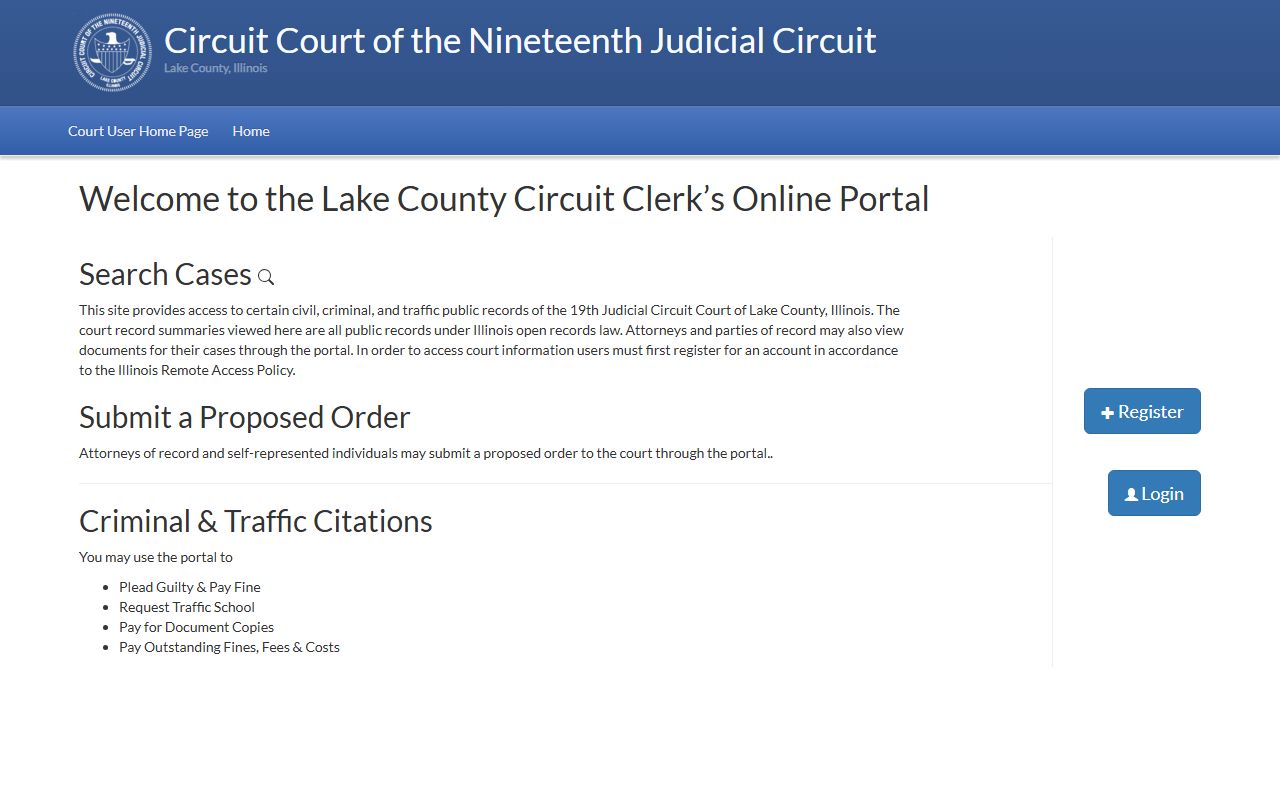
The Lake County Circuit Clerk public portal is the official front door for these records. The search-field notes below reflect what the portal documents.
| Field | Type | Required | Notes |
|---|---|---|---|
| Account registration | Login | Yes | Required for court information under the Illinois Remote Access Policy. |
| Search Cases | Portal search | Optional | Covers certain civil, criminal, and traffic records. |
| Case number / name | Text | Optional | Exact field labels were not captured; a roster case number searches best. |
- Open the Circuit Clerk public portal and register for an account if you do not have one.
- Search by the defendant's name or by the case number from the jail roster.
- Open the case and read the charge list and case events.
- Check each charge's level and current status, and use the courthouse for records not available online.
For a statewide criminal history rather than a single case, the Illinois State Police Bureau of Identification handles criminal-history products, which is a separate system from the court docket. Most files the Clerk keeps can also be viewed in person at 18 N County Street in Waukegan. Once a case opens, the public summary usually shows the case number and type, the defendant name, the charges and counts, the filing date, court events and hearing dates, and the disposition if one has been reached, while full documents may be limited to attorneys and parties of record.
Charging Documents After a Lake County Arrest
Booking happens at the jail, but the charge record begins when the prosecutor files a charging document. There are three main types, and which one is used depends on the offense and the stage of the case. A complaint often comes first, close to the arrest. An information is a prosecutor-filed document used for many cases, and an indictment comes from a grand jury for more serious felonies.
| Complaint | Information | Indictment | |
|---|---|---|---|
| Filed By | Officer / Prosecutor | Prosecutor | Grand Jury |
| Common For | Misdemeanors | Many felonies | Serious felonies |
| Starts | The case | The case | The case |
The State's Attorney can file charges that differ from the officer's booking description, and a later charging document can replace an earlier one. That is why the roster is a starting point, not the final word on what a person is charged with in court.
Lake County Charge Status After Arrest
Charges move as a case proceeds. They can be amended, reduced, added, or dropped, and the booking charges on the jail roster can differ from what the prosecutor finally files. The Criminal Division of the 19th Circuit is split into a Felony Section and a Misdemeanor and Traffic Section, each with a presiding judge, so a case is routed by charge level. The common status terms are below.
| Status | What It Means |
|---|---|
| Pending | The case is open and moving through the court; no final outcome yet. |
| Amended / Reduced | The charge was changed, often to a different count or a lower level. |
| Dismissed | The charge was dropped and is no longer being pursued. |
| Nolle Prosequi | The prosecutor formally chose not to pursue the charge. |
Lake County Bond and Release After Arrest
Illinois changed how release works. Under the Pretrial Fairness Act, the state moved away from a commercial cash-bail system for new cases, so release conditions and any request to detain are decided by the court rather than by posting a set dollar amount. The county's operational pages still use the words bond and self-release because court orders, older cases, fines, and jail payment workflows can still involve money. A roster value of Not Bondable means money alone will not release the person.
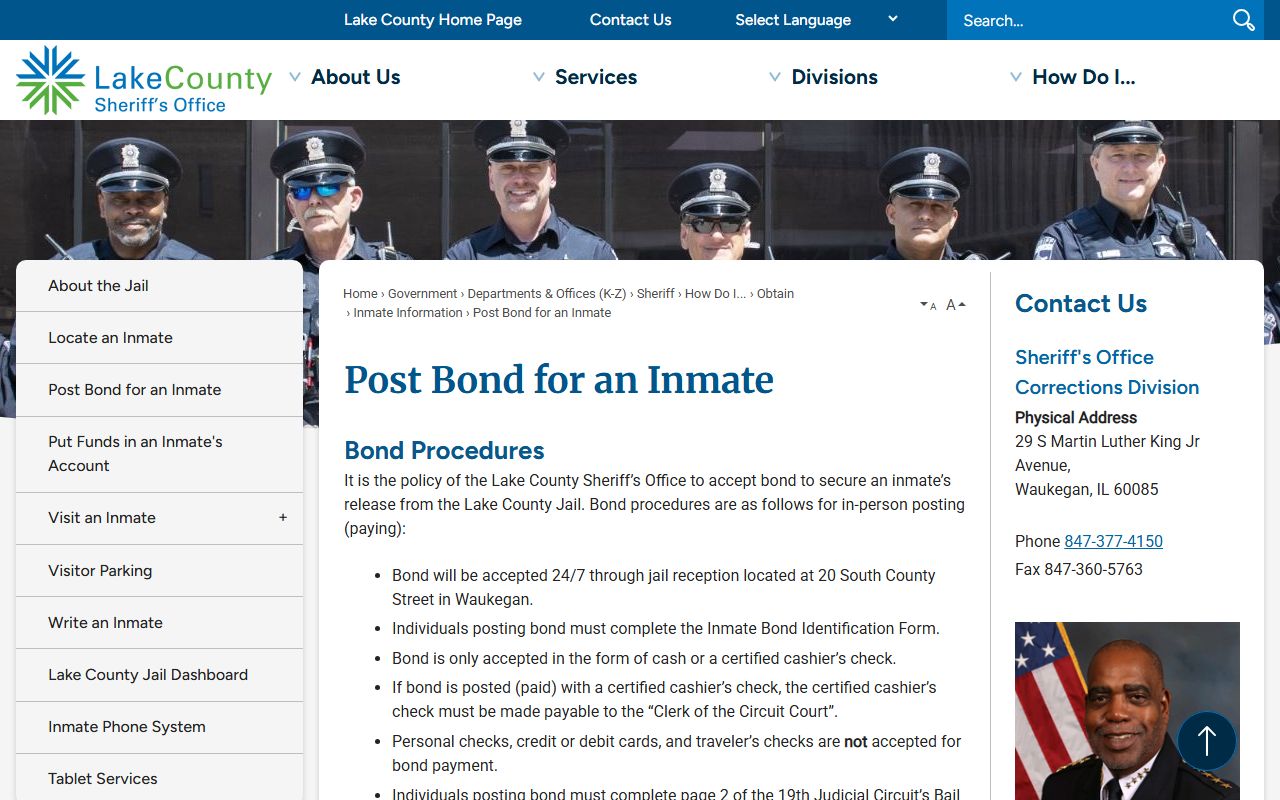
The Sheriff's Post Bond for an Inmate page explains in-person posting and self-release funding, with bond reception open 24/7 at 20 South County Street. The table sums up how release works in practice.
| Release Type | How It Works in Illinois |
|---|---|
| Pretrial release | The court sets conditions for release while the case is pending, without a cash-bail payment for new cases. |
| Court-ordered bond | Older cases, fines, or court orders can still require cash or a certified cashier's check at jail reception. |
| Detention | The court can order a person held when the law allows a detention request. |
| No-bond hold / detainer | A hold from another case or agency can keep someone in custody regardless of payment. |
Warrants and a Lake County Arrest
Many arrests start with a warrant. The Lake County Sheriff's Office enforces criminal warrants from the Circuit Court, and once entered into local, state, and national databases, a warrant stays active until the person is arrested or a court cancels it. A warrant arrest can put a person on the jail roster after booking, and the underlying order shows in the court case.
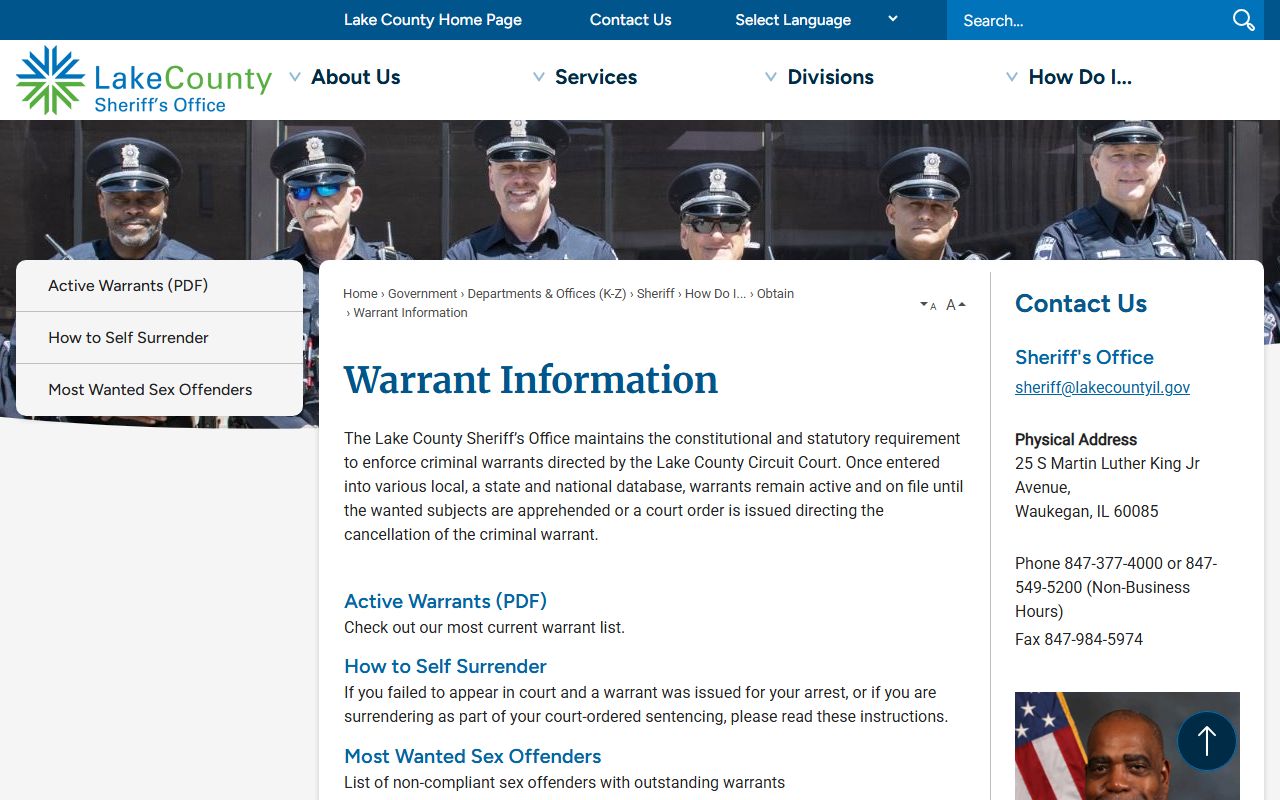
The Sheriff's Warrant Information hub points to three public paths: an Active Warrants PDF, a self-surrender page, and a most-wanted list for non-compliant sex offenders. The county warns the public not to approach a wanted person and to call 847-549-5200 or Crime Stoppers at 847-662-2222 instead.
Lake County Charges vs. Convictions
An arrest and a filed charge are not a conviction. A charge is an accusation that the case still has to prove, while a conviction is the outcome after a plea or a verdict. Both can appear in public records, but they mean very different things.
| Charge | Conviction | |
|---|---|---|
| Stage | Accusation | Verdict or plea |
| Burden of Proof | Probable cause | Beyond a reasonable doubt |
| Public Record | Yes | Yes |
Note: A dismissed or reduced charge can still appear in the court file even though it never became a conviction, so read the disposition, not just the original charge.
Sealed vs. Expunged Arrest Records
Illinois law lets eligible people clear an arrest or charge record after a dismissal or another qualifying outcome. The Criminal Identification Act governs expungement, sealing, and immediate sealing. Sealing hides a record from most public view, while expungement treats it as though it never existed. Eligibility depends on the charge and the outcome.
| Sealed | Expunged | |
|---|---|---|
| Visibility | Hidden from public view | Destroyed or treated as never existing |
| Law Enforcement | Limited access | Very limited access |
| Eligibility | Set by 20 ILCS 2630/5.2 and the disposition | Often for dismissals and eligible outcomes |
Background Check Considerations
Public court records are open, but using them is not the same as running a regulated background check. A formal employment, tenant, credit, or insurance screening is governed by the Fair Credit Reporting Act and must come from a consumer reporting agency that follows its rules. A casual lookup of court records after an arrest is not a substitute, and the two should not be mixed.
Important: This site is not a consumer reporting agency and its content may not be used for credit, employment, tenant, or insurance decisions covered by the FCRA.
Restricted Lake County Court Records
Not every record after an arrest is open. The portal provides only certain records, and sealed, impounded, juvenile, and expunged cases are not part of public search. Juvenile arrests carry their own confidentiality rules. A very recent arrest can also create a gap, since the booking may show on the jail roster before the formal court case is searchable. When a record is not online, the courthouse at 18 N County Street is the fallback for files the Clerk keeps, while booking and jail records go to the Sheriff rather than the court.