
The Lake County Inmate Population
The Lake County inmate population is held almost entirely at the Lake County Sheriff's Adult Corrections Facility, the county jail in downtown Waukegan. The Sheriff's Office Corrections Division runs the facility and reports the numbers behind it. The jail holds adults who are waiting for trial, people serving short county sentences, and inmates brought in for court. Illinois law caps a county jail sentence at no more than 364 days, so anyone sentenced to a longer prison term is moved into the state system rather than counted here.
Several things push the count up or down. Arrests by the sheriff and by city police departments across the county add new bookings every day. Release decisions, sentencings, and transfers to the Illinois Department of Corrections move people off the roster. In 2024 a staffing shortage led the county to house some inmates at a neighboring jail, which spread part of the population to a second location for a time. The makeup of the group is tracked on a public jail dashboard the county built with Loyola University Chicago.
Lake County Inmate Population Statistics
The headline figures come from the Sheriff's Office, mostly through its annual jail inspection releases and its press information page. The jail is rated for 740 beds. Recent average daily population has run in the 500s and high 500s, well under the rated bed count. The county does not publish a live numeric snapshot in plain text, so the figures below are the most recent sourced numbers rather than a real-time tally.
A look at the official jail dashboard explainer shows how the county frames this data for the public. The Lake County CJCC jail dashboard page describes daily and monthly population counts broken out by race, gender, age, and charge level.
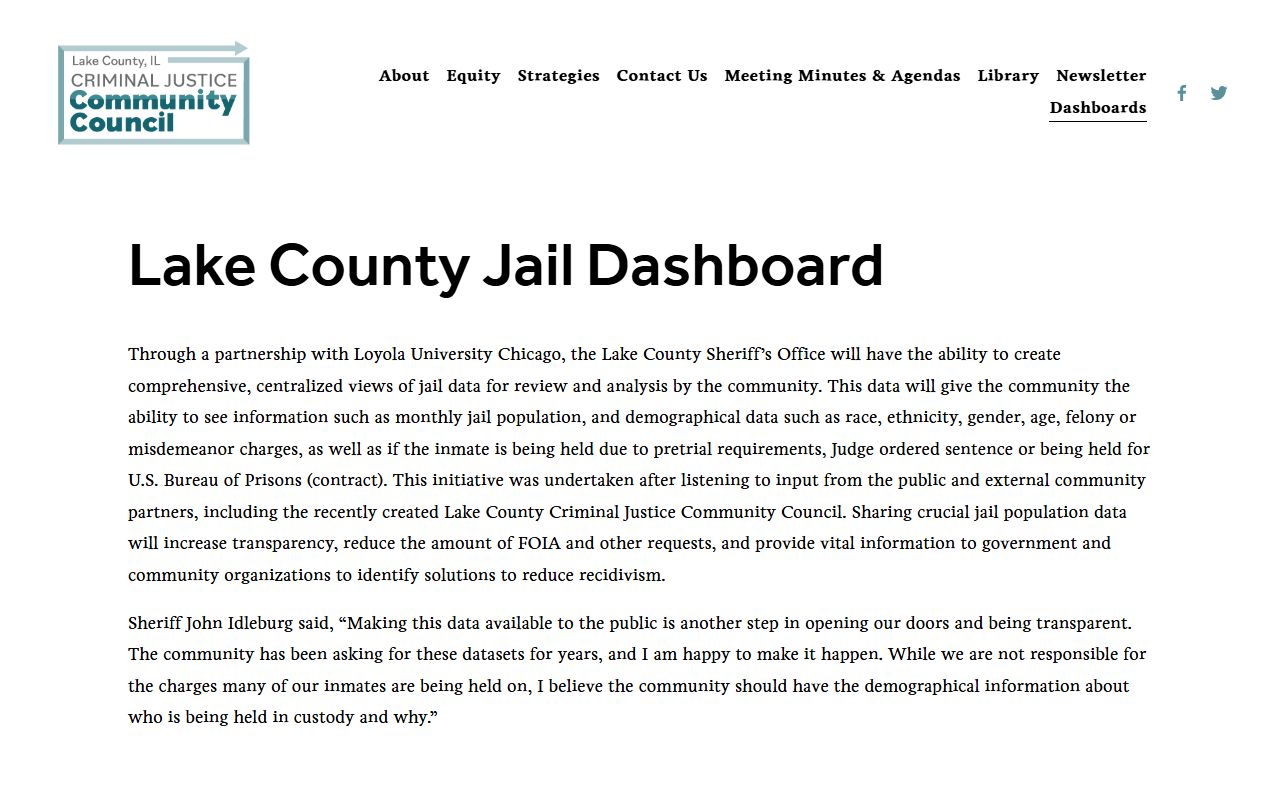
That dashboard turns the raw inmate population into categories families and researchers can read, and it is the clearest official window into who is held in the jail on a given day.
| Measure | Figure | Source / Year |
|---|---|---|
| Average daily population | 597 | Sheriff inspection release, Jan-Nov 2025 |
| Rated bed capacity | 740 | Sheriff, About the Jail (current) |
| New inmates processed | 4,800+ | Sheriff inspection release, through Nov 2025 |
| Sentenced share of population | About 20% | Sheriff, Consider a Career in Corrections |
Note: The 2025 booking and population numbers are partial-year figures from an inspection release, so they should not be read as final full-year totals.
Lake County Inmate Population Trends
The county's own inspection releases and press pages give several years of average daily population, which is the cleanest way to track the trend. Read carefully, the figures show a dip during the early 2020s and a return toward pre-2020 levels by the 2025 reporting period. The 2025 average daily population of 597 sits very close to the 2019 figure of 593, which suggests the inmate population recovered after softer partial-year counts in 2021 and 2024.
| Year / Period | Average Daily Population | Notes |
|---|---|---|
| 2019 (full year) | 593 | 7,264 bookings and 7,302 releases reported. |
| Jan-May 2021 | 525 | Partial-year figure from an official inspection release. |
| Jan-Jun 2024 | 515 | Partial-year figure; over 2,700 new inmates in six months. |
| Jan-Nov 2025 | 597 | Partial-year figure; over 4,800 new inmates through November. |
One driver behind the recent numbers was not a bed shortage at all. The 2024 strain came from staffing, not overcrowding, and the county reported it was running close to 40% below normal corrections staffing that year.
Lake County Inmate Population Makeup
Most people in the jail have not been convicted. Reform research tied to the county's work in the MacArthur Safety and Justice Challenge found that the share held before trial has run very high, with a 2017 profile putting it near 80%. The Sheriff's Office separately reports that about a fifth of the population is serving a sentence at any given time. The rest are waiting on a case, a hearing, or a transfer.
- Pre-trial vs sentenced - A 2017 reform profile put roughly 80% of the population in pre-trial status, while the sheriff reports about 20% are serving sentences.
- Charge level - The jail dashboard tracks felony and misdemeanor charges; roster samples show classes from Class C misdemeanor up to Class 2 felony.
- Held for other systems - The dashboard includes a federal Bureau of Prisons contract category for people housed under agreement.
- Race and ethnicity - County and Loyola analysis of 2019 admissions reported White 39%, Black 35%, Hispanic 23%, and other 3%, a Black share far above the county's 7% population share.
Note: The racial admissions figures come from a Loyola analysis of sheriff data and reflect 2019 bookings, not the current daily count.
Lake County Jail Capacity and Overcrowding
The jail is rated for 740 inmates, and the recent population has stayed below that line. At a 2025 average daily population of 597, the jail ran near 81% of rated capacity. The 2024 partial-year figure of 515 worked out to about 70%, and the 2019 average of 593 was close to 80%. No official source reviewed describes the Lake County jail as currently over its rated bed count.
The pressure that made news was different. In January 2024 the sheriff announced a temporary agreement to house up to 150 Lake County inmates at the McHenry County Jail because the Corrections Division was badly short staffed. The deal ran at a set daily rate per inmate, and McHenry agreed to bring those inmates back for required Lake County court dates. Families were told to call the county first to learn where a person was actually being held. The takeaway is that a staffing crisis, not a lack of beds, drove that overflow.
Important: A Lake County inmate could be physically housed at a contract jail during a staffing shortage, so confirm the location by phone before traveling to visit or post for release.
Laws Governing the Lake County Inmate Population
The reason any of this data is public, and the rules that shape how the jail records it, come from Illinois law. Open-records statutes make jail population and booking information public unless an exemption applies, jail standards require the county to keep and report population records, and a separate law requires investigation and reporting when someone dies in custody. The statutes below set the framework, each with a short plain-English meaning.
Key Statutes:
Illinois FOIA, 5 ILCS 140 - Records held by public bodies, including jail and inmate data, are presumed open unless a specific exemption applies.
5 ILCS 140/2.15 - Law enforcement must furnish core arrest-report information, including charges, arrest timing, and a photograph when available, generally within 72 hours.
20 Ill. Adm. Code Part 701 - The Illinois County Jail Standards require monthly population reporting and detailed booking records for every detainee.
Reporting of Deaths in Custody Act - Deaths in correctional custody must be investigated and reported to the state, with public summaries.
The county jail standards matter most for the raw count, since they require gender and sentence-category tallies the public dashboard then draws from.
Lake County and the Illinois Prison Population
The county jail is only one part of the custody picture. When a person from Lake County is convicted and sentenced to more than a year, they leave the jail and join the Illinois Department of Corrections population. No state prison sits inside Lake County, so a sentenced inmate is held at an IDOC facility elsewhere in the state. At that point the county roster no longer lists them, and the right tool becomes the Illinois Department of Corrections individual in custody search. The state locator covers sentenced prisoners statewide and is a separate database from the county jail roster.
Search the Lake County Inmate Population
The county runs its inmate search through a Tyler-hosted public portal, linked from the Sheriff's official "Locate an Inmate" page. The roster is free, needs no login for current inmates, and is the gold-standard starting point for a Lake County inmate search. A look at the actual search screen makes the steps clear.
Before starting, have a name ready. A booking number or sheriff's office number helps if a common surname returns many matches.
The Lake County Sheriff inmate records search opens the current-inmate list.
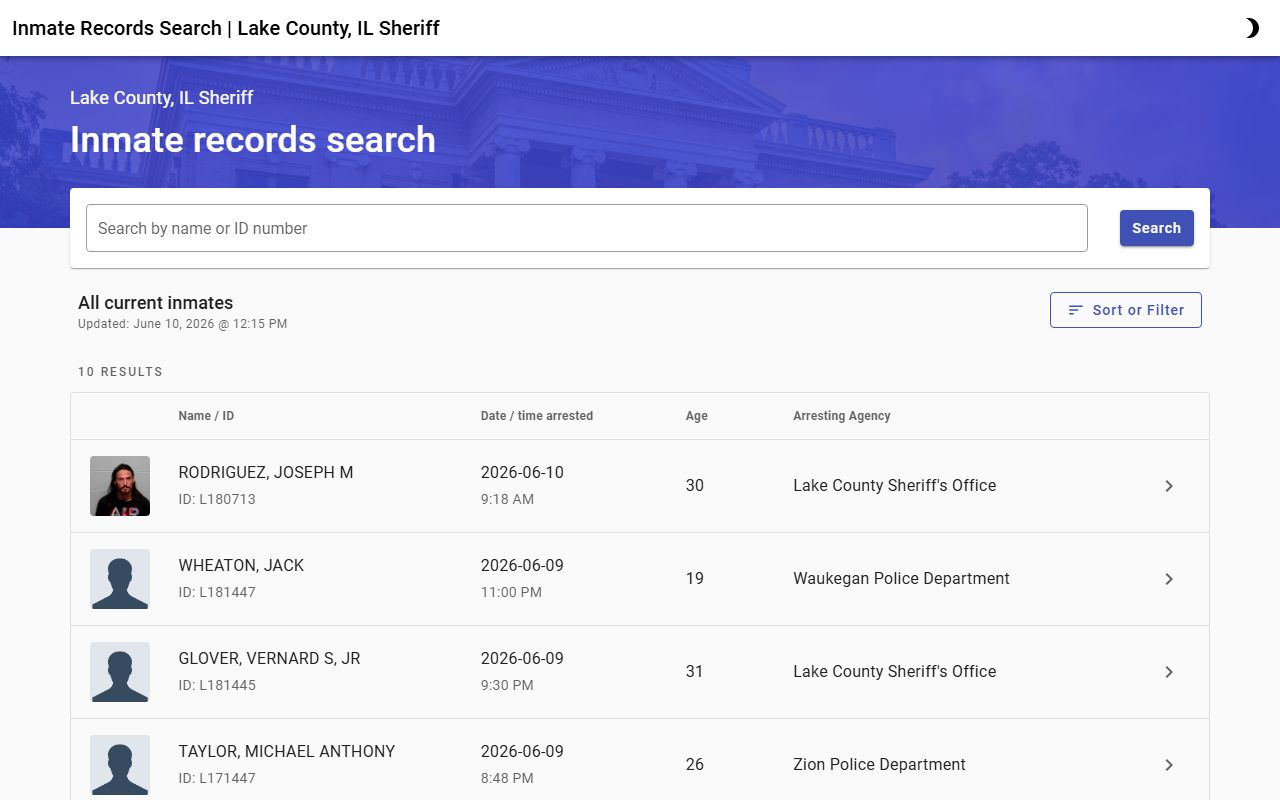
That screen is the same portal the official county page points to, so families do not need to use any third-party search site to find a current inmate.
- Open the Sheriff's Locate an Inmate page, not a private lookup site.
- Follow the inmate search link to the Tyler correctionsrecordssearch.com portal for Lake County.
- Use the search box and review the current-inmate list, paging through results if the count is high.
- Open a result to read booking number, charges, arresting agency, and any bond or hold details.
- If the person was sentenced to prison, search the Illinois DOC locator instead of the county roster.
Current Inmate Lookup in Lake County
The live roster covers people currently in the Lake County jail. The portal carries a machine-readable update timestamp, and an inspection of the public data on June 10, 2026 showed it stamped that same day, with roughly 630 current records paged in small batches. Because the portal is built in JavaScript, the public search screen exposes a general search box rather than a long form of separate fields. The table below reflects what the research actually documented, not a guessed set of inputs.
| Field | Type | Required | Notes |
|---|---|---|---|
| Search box | Text | Optional | General search across all current inmates. |
| Pagination | Control | Automatic | Results page in small batches, about ten per page. |
| Sort controls | UI control | Optional | The list can be sorted; static labels were not visible. |
Past and Released Inmate Records
The county portal is built around current inmates. Lake County's official material describes it as a current-inmate search and does not confirm a public history of released bookings on that portal. Once a person is released, their record may drop from the public roster. To find a past booking, the reliable route is a public-records request to the Sheriff's Office or the Jail for the booking record. For anyone sentenced to state prison, the search moves to the Illinois DOC locator, since the county roster stops tracking them after transfer. VINELink can also be used to register for custody and release notifications.
What a Lake County Inmate Record Shows
A current-inmate record carries far more than a name. Inspection of the public roster data showed booking identifiers, names in last-name-first format, demographics, arresting agency, charges with a class or degree, and bond or hold values on some records. Not every field appears for every person, and some, such as a housing unit, were not exposed in the public data at all.
| Field | What It Shows |
|---|---|
| Booking Number | Record ID, usually the year plus a sequence, such as 2026-02635. |
| Booking Date | Date and time the person was booked into the jail. |
| Charges | Offense description with a class or degree, like Class 2 Felony or Class A Misdemeanor. |
| Bond / Hold | Bond or hold status when present, including values such as Not Bondable. |
| Housing Unit | Not shown in the public roster data inspected. |
| Custody Status | A released flag indicates whether the person is still in custody. |
A few jail and court terms come up again and again when reading a record. The short glossary below defines the ones that confuse people most.
- Not Bondable
- A roster value meaning money alone will not release the person; a court order controls release.
- Hold / Detainer
- A custody reason from another case, warrant, or agency that can keep someone in jail.
- Remand
- A court order placing a person back into custody.
- Classification
- The jail's assessment that decides housing and security level after booking.
- IDOC
- The Illinois Department of Corrections, the state prison system for sentenced felons.
County Jail vs. Illinois State Prison
People often search the wrong system. Pre-trial detainees and those serving short county sentences sit in the Lake County jail and appear on the county roster. Once a person is sentenced to more than 364 days, they transfer to an Illinois Department of Corrections prison and appear in the state locator instead. The table below sorts out which tool covers which part of the inmate population.
| County Jail | State Prison (IDOC) | |
|---|---|---|
| Who Is Held | Pre-trial and short sentences | Sentenced felons |
| Run By | Lake County Sheriff's Office | Illinois Department of Corrections (IDOC) |
| Where to Look | County jail roster | State individual-in-custody search |
| Stays Listed | While in county custody | Through the state sentence |
State and Federal Inmate Search
Beyond the county jail, three other locators cover the rest of the inmate population that touches Lake County. The Illinois DOC search covers sentenced state prisoners, the federal Bureau of Prisons locator covers federal sentenced inmates from 1982 forward, and the ICE detainee locator covers immigration custody. None of these replaces the county roster, and each tracks a different slice. The state search is the most common follow-up once a person is sentenced.
The statewide tool, the Illinois Department of Corrections individual in custody search, accepts a last name, an IDOC number, or a birthdate.
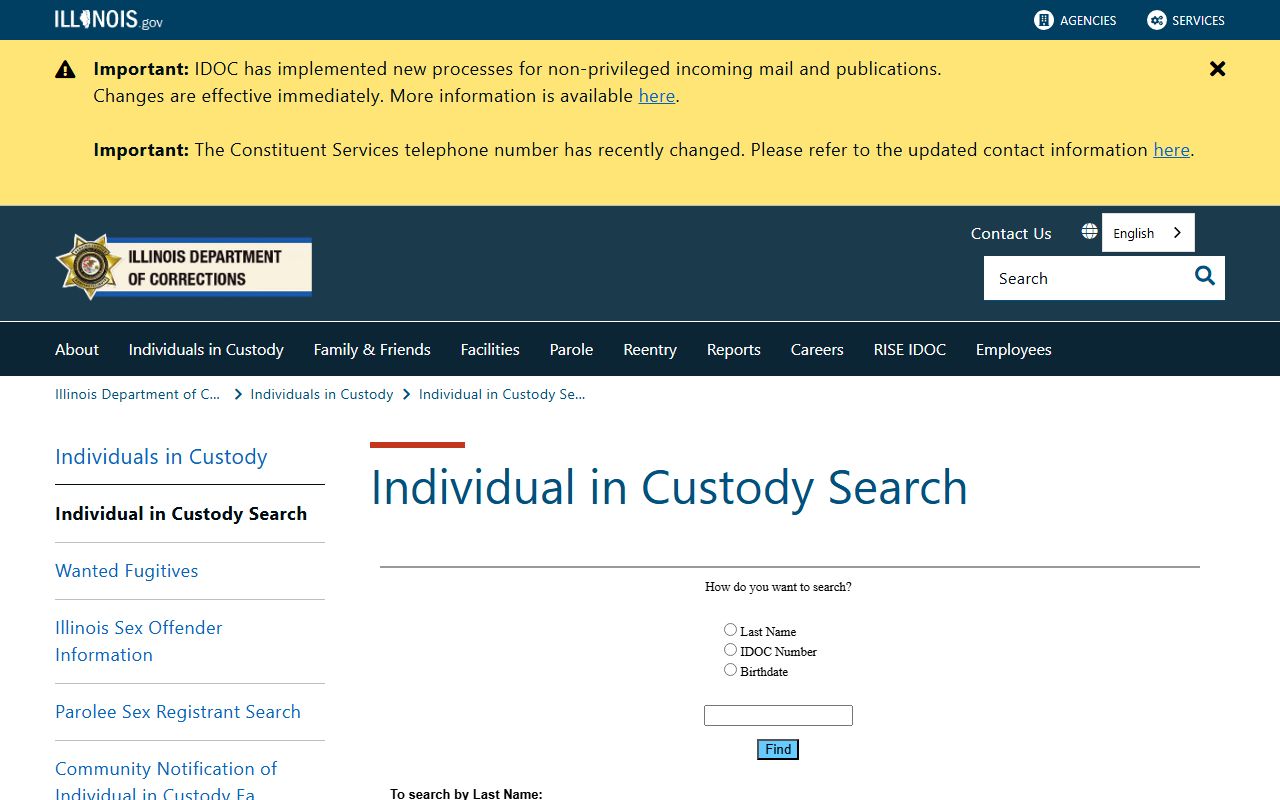
That search returns the sentenced prisoners who have left the Lake County jail, which is why it is the right tool once a case ends in a prison sentence. Federal custody uses the BOP inmate locator, immigration custody uses the ICE detainee locator, and release alerts come through Illinois VINELink.
Lake County Detention Facilities
The county inmate population spreads across a primary jail, a community corrections location, and, during the 2024 staffing shortage, a contract jail in a neighboring county. Each holds a different part of the population, so the right page depends on who is held where.
- Lake County Sheriff's Adult Corrections Facility - The main Waukegan jail for pre-trial detainees and county-sentenced inmates.
- Lake County Sheriff's Community Based Corrections - Electronic home monitoring, periodic imprisonment, and pre-trial bond supervision, not the main booking jail.
- McHenry County Jail - A neighboring jail that temporarily housed some Lake County inmates under a 2024 staffing agreement.
Lake County Inmate Population FAQ
How big is the Lake County inmate population?
The jail is rated for 740 beds. Recent average daily population has run in the 500s, with a 2025 partial-year figure of 597, close to the 2019 figure of 593. The county processed more than 4,800 new inmates through November 2025, so the daily count turns over many times across a year.
How do I search the Lake County inmate population?
Start at the Sheriff's Locate an Inmate page and follow it to the Tyler inmate records portal, which lists current inmates for free. Use the search box, page through the list, and open a record for charges, arresting agency, and bond or hold details. For sentenced prisoners, use the Illinois DOC locator instead.
Can I look up a released or past inmate?
The county portal is built for current inmates, so a released person may drop off it. To find a past booking, file a records request with the Sheriff's Office or Jail. If the person was sentenced to prison, the Illinois DOC search will show them, and VINELink can send custody and release alerts.
Why might someone not appear on the roster?
A very new booking may not have posted yet, the person may have been released, or they may have been moved to state, federal, or immigration custody. During the 2024 staffing shortage, some Lake County inmates were housed at the McHenry County Jail, so a call to the county was needed to confirm the location.
What does "Not Bondable" mean on a record?
It means paying money alone will not release the person. A court order, a hold, or a detainer is controlling that person's release, so the family should check the court case or call the jail rather than assume a deposit will free them.
Is the Lake County jail overcrowded?
No official source reviewed describes the jail as over its 740-bed rating. Recent population has stayed below capacity. The 2024 transfer of some inmates to McHenry came from a staffing shortage, not a bed shortage.